

Exploring what it means to be human, one story at a time.
Elena: Reading from The Garden of Hope - Perfume. A story of growth.
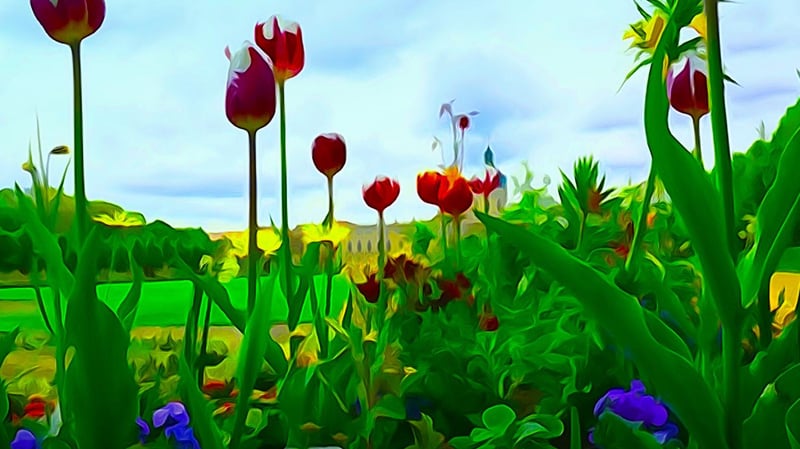
A soft breeze blew through the arched openings and brought with it the scent of flowers. Cimmy couldn’t figure out what flowers those were, but their fragrance was deeply anchored into her memories, a strange thing, really, because none of her pasts had characteristics which would allow for the heavenly fragrance, and she suddenly realized it was a scent from her Garden, roses, she was sure of it, even if she’d never seen roses before. Damasks, she elaborated. Definitely Damasks.

The first thing Cimmy saw when she opened her eyes that morning was an intricate wooden vault, whose ribs intertwined and transformed in spellbinding ways, drawing her attention from one detail to another.
“Are you going to start working or are you going to keep staring at the ceiling? By all means, let your patients stew in their problems until you’re done contemplating the meaning of life.”
‘Patients?’ Cimmy thought. ‘What’s a patient?’
The irony of Bertha’s comment about not keeping the patients waiting didn’t escape her, and she got up to examine the rest of the space.
The room was flooded with light, even at this early hour, and it was stunningly spacious and grand, a far cry from what she was used to.
The structure was built of flexible wooden branches, which were smooth and remarkably uniform. It featured vaults and arched openings that looked out to the sea and the forest.
Its walls were lined with shelves, holding a collection of books and jars filled with dried herbs and potions.
In the middle of the room, on a large table covered in anatomical and botanical drawings, the diseased book ruled supreme.
‘I jumped again,’ was Cimmy’s first thought. She looked around to find Fay, who wasn’t anywhere in sight, and turned towards Bertha, who seemed to have no recollection of the fact Cimmy had ever been banished.
“Where is Fay?” she asked, worried.
“At home, of course. You may be so eccentric as to keep a pet rat, but the rest of us don’t appreciate the danger to health that critter poses. Keeping a rat in the apothecary! That’s precious! Have you finished the readings I gave you last week?”
‘You mean to say this is not where I live? I have another place, just to sleep?’
She remembered having woken up there and asked out loud.
“Did I sleep here?”
“I stopped trying to figure out why you do anything a long time ago,” Bertha went on the offensive. “Maybe the effort of actually moving your from one place to the other didn’t sit well with you today. Thank god that friend of yours remembers to feed your rat when you take leave of reality to go to whatever crazy entices you that day. You seem to have no sense of responsibility. Normal people actually feel guilty when they don’t tend to their duties.”
‘Oh, great,’ Cimmy thought, ignoring the familiar diatribe. ‘Rahima is here too.’
As long as she had her friend and her pet, life was going to be ok.
She got up and picked a tome from the shelf, and noticed it was made of the same whitish substance they had found in the stream, only thicker, smoother and more resilient, and brought the book closer to her face, to examine its details.
“I could swear nothing you do could give me pause anymore, but this is strange, even for you: are you getting confused by paper? I haven’t seen that expression before, except maybe once, on a lemur.”
‘What’s a lemur,’ Cimmy wanted to ask, and then reconsidered, planned to find out all by herself later and put the book back on the shelf.
The day passed slowly, with only a few minor injuries and upset stomachs. This allowed her to dedicate a lot of time to examining the rest of the books. With each one she opened, her excitement grew, eventually bringing her to tears.
In every tome, in exquisite detail, old illnesses and afflictions had elaborate descriptions and cures, explanations for why they happened, diagnostic tools, recipes for medicine.
“Are you admiring your own work?” Rahima mocked her. She was standing in the doorway, holding a little basket of food, and she had brought Fay, who was sitting on her shoulder.
“Fay!” Cimmy turned around, excited.
“Don’t worry, I fed him,” Rahima was taken aback by this strange display of emotion. “I swear, if he tries to get in my hair, I’ll hate you forever. Have you had anything to eat today?”
Cimmy wasn’t hungry, so she assumed she must have, only to be contradicted by Rahima’s firm hand gesture. The latter had put the basket on the table and dragged her there, forcing her to sit down.
One by one, unfamiliar treats came out of the basket, all wrapped in clean linens and smelling delicious.
‘Who in creation ever forgets to eat? Especially when food smells like this,’ Cimmy wondered.
She frowned unconsciously as memories of starvation and the oxalic taste of the bitter roots resurfaced.
“I thought these were your favorites!” Rahima looked offended. “I took a half hour detour just to get them for you.”
“You didn’t make these?” Cimmy wondered.
“Cimmy, I know you have important work to do, but the rest of us don’t sit around twiddling our thumbs, either. I wouldn’t have time to bake, even if I knew how.”
Cimmy wanted to ask Rahima who found the diseased book and when, but knew there was no point in referring to histories unshared, and was sure her friend wouldn’t have any idea what she was talking about.
How curious was it that Rahima’s personality and demeanor kept getting mirrored in all these overwritten versions of life, perfectly recognizable and fundamentally unchanged?
The Rahima who made an extra effort to bring Cimmy her favorite foods was the same Rahima who shared her bitter roots with her, at the risk of starvation.
“How lucky am I to have a friend like you!” Cimmy blurted out, a little embarrassed by the raw display of emotions.
“Yeah, you’re weird.” Rahima examined her with an amused and detached gaze. “Eat! You’ll start seeing things next.”
Cimmy obeyed, surprised at the familiar taste of the food, and wondering if all these overwritten realities which kept her skipping forward by leaps and bounds weren’t all connected somehow, at their core, by a fundamental and unchangeable essence which was the real existence, and for which all the ephemeral transformations were irrelevant details.
“How was your day?” She asked Rahima, with the hope the latter would get chatty about her whereabouts, so Cimmy could orient herself around her friend’s life without having to ask questions that would make the latter worry she’d lost her mind.
Rahima was glad to share the plethora of details, emotions, and surprises of the day, and discussed her projects, lectures, and field trips.
Now that she had discovered her friend's occupation, Cimmy felt encouraged to participate in the conversation.
“Do you like being a teacher?”
“Teacher? I guess I never thought of it like that. I suppose taking care of the art room has some similarities to teaching, yeah, no, not really. Cimmy, are you ok?”
Art caretaker? Could one claim caring for art as a profession now?
“Yes, of course. This is delicious.” She pointed to the baked goods to change the subject. A soft breeze blew through the arched openings and brought with it the scent of flowers. Cimmy couldn’t figure out what flowers those were, but their fragrance was deeply anchored into her memories, a strange thing, really, because none of her pasts had characteristics which would allow for the heavenly fragrance, and she suddenly realized it was a scent from her Garden, roses, she was sure of it, even if she’d never seen roses before. Damasks, she elaborated. Definitely Damasks.
She worried Rahima would think her crazy, but couldn’t help herself.
“That smell! Are those roses?”
“Yes,” Rahima nodded, pleased. “My new perfume, I got it yesterday. Do you like it?”
Cimmy was so perplexed by the idea of her friend smelling like one of her imaginary flowers that she couldn't respond.
“You don’t like it?” Rahima’s face darkened in disappointment.
“No, it’s lovely,” Cimmy rushed to reassure her. “I just didn’t realize one could steal the scent from a flower.”
It did make sense, though: if one could steal the healing essence from a plant, and its color, why not its smell too?
“Ever since they invented perfume,” Rahima mocked her, while grabbing Fay from her own shoulder and placing it in Cimmy’s hands. “Now that you’ve eaten, take your beast and go home. People are coming to see the new paintings, and I don’t want to make them wait.”
“Can I come?”
“Of course,” Rahima hesitated, surprised. “I didn’t think you’d be interested, since when are you excited about art?”
The return of another overwritten past brought back the heartbreaking memory of Cimmy's treasured artifacts fueling a bonfire. What was one to do with all the pasts that had never been, with whom was one to share their weight of nonexistent memories? How could a past that never happened make one sad?
“What, a healer can’t appreciate beautiful things?” Cimmy brushed off the burden of her inexistent past.
“Art is not about beauty,” Rahima started to engage in a sophisticated argument about different forms of expression, but met Cimmy’s tearful gaze and felt guilty for upsetting her friend.
“I’m sorry, Cimmy. I didn’t mean to sound condescending.”
“Can I bring Fay with me?”
Rahima didn’t want to further upset her friend, and reluctantly agreed, all the while wondering what kind of nut brings a rat to an art showing.
“Ah, sure, yes. You can bring Fay.”
Thank you for reading.
If something here stays with you, you’ll find more stories, essays, books, and spoken work at francisrosenfeld.com.
© 2026 Francis Rosenfeld. All Rights Reserved.

Comments
No comments yet. Be the first to comment!