

Exploring what it means to be human, one story at a time.
Amelia: Reading from The Gates of Horn and Ivory - Inspired
Because they had been so impactful in every aspect of human culture, people often forgot how young the muses were, and still possessed with the boisterousness of childhood, and they could run a person ragged when they focused their attention on them.
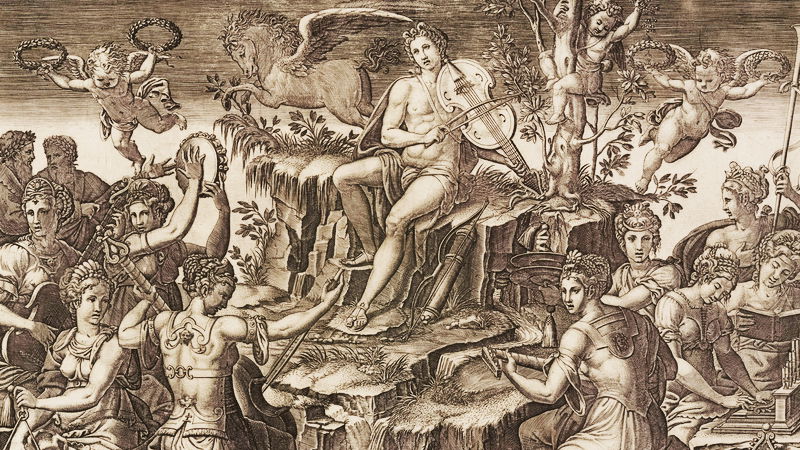

Every four years in the middle of summer, the mortals gathered to celebrate the muses in a gentle valley at the feet of Mount Helicon.
The nine daughters of Mnemosyne, they weren’t your usual goddesses; they were a gift to humankind. Nobody talked about them as such, out of fear these wonders that fired the human mind to create masterpieces might be taken away, to leave mankind only the toiling and the wars, a drab existence made of hopeless and uninspiring days, all the same.
The muses were born of the goddess of memory and the highest of the gods, a splendid metaphor for the mind’s union with the sublime.

And, just as happens with the human minds, their relationships and connections with other gods and with the mortals got complicated from there.
Unexpected friendships and mentoring roles emerged, and if one wanted to understand them, one had to know their whole family history.
Pegasus himself had struck the ground with its hoof to open their source of inspiration, the stream of Hippocrene.
Their mother, Mnemosyne, the keeper of the fount of memories in Hades, was Hypnos’s neighbor and friend.
Remembering is the opposite of forgetting, and therefore, it embodies the same concept. They are two halves of the same whole.
Every object in a universe of duality must have an opposite, and the two opposing elements are intrinsically the same essence.
They are what is, reflecting itself into what it is not.
So, naturally, Mnemosyne and Hypnos had strong ties of common understanding, and her nine daughters, who had grown up around the morose god of sleep, felt great affection and kinship towards him.
One would wonder how the muses became the disciples of Apollo, if one didn’t know the latter spent every night in Hades, floating down an underworld river or another in a large golden cup until sunrise.
As I mentioned, the gods liked to exchange aspects with each other, appearing in whatever form best suited their purpose, and in time, Apollo and Helios became indistinguishable from each other.
Many a time had the radiant deity passed them by, his makeshift golden vessel gliding slowly on the waters of the Acheron, in the shade of the mournful Heliades, playing his lyre and singing melancholy tunes to accompany his daughters’ dirge.
It took everybody by surprise, when they got to know Apollo better, that the sun god was not at all cheerful and extroverted, as one would expect, and felt more in his element at funerals than he did at joyful celebrations.
So, caught between their mother’s analytical detachment and their uncles’ melancholy temperaments, the muses grew up sensitive, artistic and given to strong emotional expression, which they doled up on the world in poetry, music and dance.
A couple of them took after their mother and followed more exact fields of interest, such as history and astronomy, while the drama queens, Thalia and Melpomene, who never showed up anywhere without their comic and tragic masks, inspired theater.
They were beautiful, willful and unencumbered, the muses, and their creativity and passions fired human thought, inspiring literary masterpieces and beautiful works of art, but most of all, music, which seemed to resonate and flow directly from their beatific voices.
Poets, playwrights, bards, philosophers and scientists revered them and worshipped at their feet, and would walk across rivers of fire hoping to receive even one drop of their divine inspiration.
Their mother, Mnemosyne, rarely left Hades, since memories are safest when kept buried in deep recesses, and because she could never be there for her daughters during the summer Mouseia, she organized her own festivities, in the underworld, to celebrate their nine consecutive birthdays.
Celebrations were scarce in Hades, where everyone, except for the blessed and the damned, waited patiently for the next transport topside, not the most exciting atmosphere, Persephone had to grant, so the nine days of the muses were eagerly anticipated every year and enjoyed fully, with everyone engaging in performing poetry and music, whose reverberations were carried by the waters of the Acheron and brought to the surface, to surprise and delight the occasional mortal who got exposed to them in the dead of winter.
Because they had been so impactful in every aspect of human culture, people often forgot how young the muses were, and still possessed with the boisterousness of childhood, and they could run a person ragged when they focused their attention on them.
Many a bard or poet had been brought to the edge of insanity by their presence, which was more intoxicating than wine.
Persephone could hear their giggles all the way from the palace, as they chased each other along the banks of the Acheron, to the outrage of the Heliades.
The latter, who had now forever taken the form of black poplar trees, and who mourned perpetually the death of their sibling Phaeton, crying tears of condensed sunlight, which turned into precious amber, couldn’t bear the muses’ joyful noises and frequently admonished them, threatening to discuss their behavior with their mother and their gloomy uncle, Hypnos.
The muses were particularly careful not to get on the wrong side of the latter, because his dreams were vehicles for ideas that inspired.
Their valuable conveyances, free from the burdens of worry, practicality and reason, could deliver concepts in their purest form, straight from the spheres above, to the minds of the artists, but they required the favor of the god of sleep to help make them vivid enough to be remembered in the morning.
During the rare instances when they found their uncle in a good mood, the muses liked to hang around his cave, lounging on his ebony sofas, and share stories, jokes and little fragments of melodies which mingled with the gentle whisper of the Lethe, while Hypnos, forgetting his usual brooding, joined in, running his fingers through the waters.
Between these cozy brainstorming retreats in his cave and his dramatic affectations, Hypnos had inspired many of Thalia and Melpomene’s plays, which drew upon the tragedy or the comedy of the situation, according to the personality of the muse who received them.
Terpsichore walked sheepishly behind her sisters after the Heliades admonished the group, keeping her head down to hide a smile, and when she was out of sight she burst into a flourish of twirls and pirouettes, grabbing Erato’s hands to spin around until they both got dizzy and dropped to the ground, with the sappy stems of the poppies to break their fall.
The two laughed out loud, evidently entertained by the feat, with infectious, irrepressible, self-perpetuating giggles which they seemed to pass endlessly among themselves.
“Am I getting old, or are they getting noisier every year?” Hades whispered from behind. He’d been watching Persephone follow the activities of the inspired children for some time now, quietly, in the background as he liked to do.
“They’re lovely!” Persephone replied, outraged. “They’re like a breath of fresh air. Everywhere they go, there is music and laughter. Who could ever find fault with that?”
“Hypnos,” Hades answered. “Hypnos always finds fault with that. They’re disturbing his sleep right now, even through all that poppy juice he keeps guzzling down. I already got a headache from anticipating his complaints.”
“It’s only nine days a year. He’ll be fine,” Persephone smiled. “I’m guessing Mnemosyne is going to give him a litany of all the times he wasn’t the greatest neighbor, and her memory is long. By the time she gets to the end of that list, he will be asleep again.”
She looked at Hades, suddenly feeling very young, light and inspired.
“There will be music, dancing, we’re going to hear recitations of poetry and theatrical performances, isn’t this wonderful? Why aren’t you excited?”
The god of the dead smiled, pleased to see his beloved so happy, but said nothing about her excitable state, which had obviously been induced by the proximity of the muses.
“I have to get ready,” she started pacing. “There is so much stuff to do, the flower arrangements, the incense, the attire, oh, I forgot the attire, what am I going to wear? The golden sandals, of course, and the belt. Those would go better with the crimson chiton. What do you think?” She turned to Hades, who had never, in their entire marriage, ever expressed any opinions regarding her garments. Fashions were the appanage of women and he had more important things to do.
“Persephone, sweetheart, please, move away from the window. You’re getting a little intense.”
Persephone looked at him, not understanding what he meant at first, and then pouted, displeased.
“Come on! It’s once a year! This place could do with a little overexcitement!”
“I thought you liked quiet,” Hades frowned.
Persephone, who was now a safe distance away from the driving intensity of the muses, settled down a little, awkward about acting strange towards her husband.
“Hypnos may have a point. They can be really disruptive,” she pondered, smiling, “but they’re worth it.”
“So, what are you going to wear?” Hades teased her.
“Don’t gibe! Attire is important. I am the queen. I need to look the part.”
“You are the part, my love. You could wear sackcloth and still look like the queen. Come to think of it, it would be interesting to try it out sometime, just to see what happens; you might start a trend,” he smiled.
“I’ll wear the silk gauze, if that’s all the same to you,” Persephone parried, and then got lost in her mental imagery again. “I was thinking the crimson one, but maybe white would be more appropriate for the celebration. What do you think? Red or white?”
Hades remembered both outfits, which looked as if they’d been made by the gods specifically to flatter his beloved. How did she not realize how beautiful she was? He curtailed a smile and replied.
“I’ve grown enough wisdom over the years not to pass judgment on ladies’ fashions. I like my life peaceful like that. Wear whichever one inspires you, my dear.”
Thank you for reading.
If something here stays with you, you’ll find more stories, essays, books, and spoken work at francisrosenfeld.com.
© 2026 Francis Rosenfeld. All Rights Reserved.

Comments
No comments yet. Be the first to comment!